Quick Take
- Who: Tidal, the music streaming service, is introducing a new policy for AI-generated music.
- What: The platform will label music it identifies as wholly AI-generated and stop assigning royalties to fully AI-created songs.
- When: The AI music policy is set to take effect on July 15, 2026.
- Where: The policy applies to Tidal’s streaming catalog and also covers Tidal Upload, the platform’s independent artist upload service.
- Why: Tidal says the move is designed to improve listener transparency, reduce deceptive AI uploads, and make sure royalties go to original works directly produced, written, and performed by people.
- How: Tidal will start by labeling wholly AI-generated music. As AI detection methods become more reliable, the platform may expand labeling to music that is substantially generated with AI.
- What Else: Tidal may remove or block AI-generated music linked to fraudulent activity, including artist impersonation, misleading uploads, unusual streaming behavior, or content that exploits a person’s music, name, or likeness.
Intro
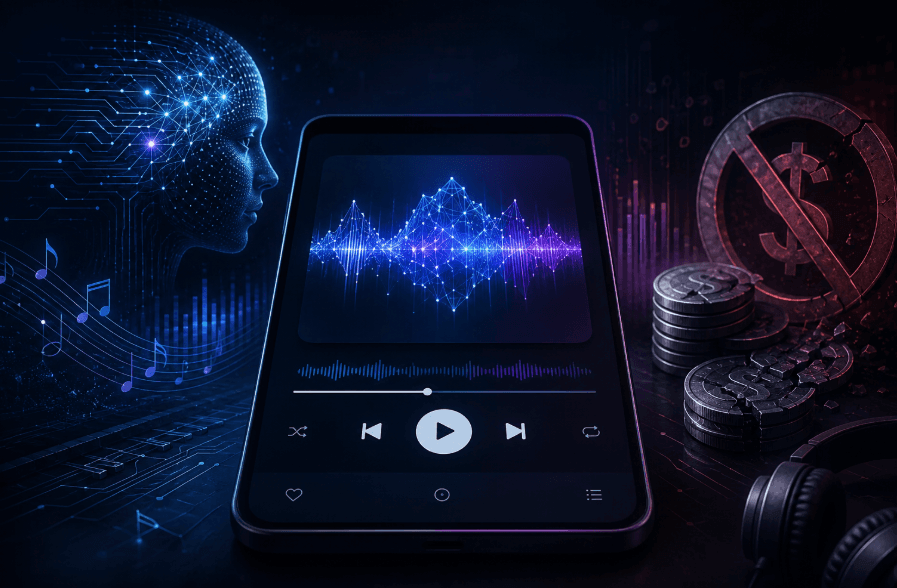
Tidal is tightening its rules on AI-generated music with a new policy that will label fully AI-created tracks and stop royalty attribution for songs identified as wholly AI-generated. The policy is scheduled to take effect on July 15, 2026, and applies to both Tidal’s streaming catalog and its independent artist upload service, Tidal Upload.
The update comes as AI music tools become easier to access and more capable of producing complete songs, synthetic vocals, instrumentals, lyrics, and full arrangements. For streaming platforms, this creates a difficult balance. AI can support creativity, but it can also increase low-quality uploads, fake artist content, voice impersonation, and songs created mainly to collect streaming revenue.
Tidal’s new policy does not amount to a full ban on AI music. Instead, it draws a clearer line between AI-assisted music and music that is wholly or substantially generated by artificial intelligence with limited human creative input. That distinction matters for artists, producers, distributors, and listeners as AI music becomes a bigger part of the streaming ecosystem.
Key Changes in Tidal’s AI Music Policy
Tidal’s AI policy focuses on three major areas: labeling, royalties, and fraud prevention. The platform says it may identify and label AI-generated content, exclude certain AI-generated tracks from royalty attribution, and remove AI music that violates content integrity rules.
| Policy Change | What It Means | Who It Affects |
|---|---|---|
| AI music labeling | Tidal will label music it identifies as wholly AI-generated. | Listeners, artists, distributors |
| Royalty restriction | Music identified as fully AI-generated will not receive royalty attribution. | AI music uploaders, rights holders |
| Fraud control | Tidal may remove AI tracks linked to impersonation, deception, or suspicious activity. | Artists, labels, streaming platforms |
| Tidal Upload coverage | The policy also applies to Tidal’s independent artist upload service. | Independent artists |
| Future expansion | Tidal may expand labeling to substantially AI-generated music as detection improves. | AI-assisted creators, distributors |
This makes the Tidal AI policy more than a simple disclosure update. It connects AI-generated music labels with monetization, which means the policy could directly affect how certain tracks earn money on the platform.
Tidal Is Not Banning All AI-Assisted Music
One of the most important points is that Tidal is not banning all AI-assisted music. The policy is mainly focused on content that is wholly or substantially generated by AI, especially when there is limited human creative input.
That means artists who use AI tools as part of a broader creative workflow may not be treated the same as people uploading fully automated AI songs. For example, a songwriter might use AI to brainstorm lyrics, test arrangement directions, clean up a demo, generate a rough instrumental reference, or explore vocal styles before recording a final track. Those uses are different from uploading a complete song generated almost entirely from a text prompt.
This distinction matters for AI music creators. As streaming platforms build stricter rules, artists will need to be more transparent about how their songs are made and how much human authorship is involved. The clearer the creative process, the lower the risk of confusion around labeling, royalties, or rights ownership.
AI-Generated vs AI-Assisted Music
The biggest question for many creators is whether using AI in a song will affect royalties. Tidal’s policy does not treat every use of AI the same way. The difference between fully AI-generated music and AI-assisted music is likely to become more important across streaming platforms.
| Music Type | Example | Royalty Risk on Tidal | Creator Note |
| Wholly AI-generated music | A full song created almost entirely from a prompt | High | May be labeled and excluded from royalty attribution |
| Substantially AI-generated music | A track where most vocals, lyrics, and instrumentals are generated by AI | Medium to high | Tidal may expand labeling as detection improves |
| AI-assisted music | A human artist uses AI for lyric drafts, demo ideas, or arrangement support | Lower | Human authorship and disclosure matter |
| Human-made music | Written, performed, and produced mainly by people | Low | Standard royalty rules are more likely to apply |
This comparison is important because AI tools are now used in many different ways. Some creators use AI as a songwriting assistant. Others use AI to generate full tracks at scale. Tidal’s policy appears to focus more strongly on the second category.
Fully AI-Generated Songs Will Not Earn Royalties
The most significant part of Tidal’s AI music policy is the royalty restriction. Tidal says it will not knowingly attribute royalties to music it identifies as wholly AI-generated.
This connects AI labeling directly to monetization. A track may appear on the platform if it follows Tidal’s rules, but if it is identified as fully AI-generated, it will not be treated the same as human-created music in royalty calculations.
Tidal’s reasoning is that royalties should go to original works directly produced, written, and performed by people. This position reflects a broader concern across the music industry: if fully AI-generated tracks can be produced at scale and uploaded in large volumes, they may compete with human artists for streaming payouts without the same creative labor behind them.
For creators, the key question is not simply whether AI was used. The bigger question is how AI was used. A song with human writing, performance, production, editing, and creative direction may be viewed differently from a track created almost entirely by a generative AI system.
Tidal Will Target AI Impersonation and Fraud
Tidal’s policy also focuses on AI-generated music connected to fraudulent activity. The platform may remove or block content that misleads listeners, impersonates real artists, interferes with authentic artists and their audiences, or appears to be tied to unusual streaming behavior.
This is especially important because AI voice tools can make it easier to imitate well-known singers, rappers, and performers. If a track sounds like a famous artist but was not authorized by that artist, it can confuse listeners and harm the artist’s reputation, brand, and rights.
Fraudulent AI music can also affect streaming platforms themselves. Large volumes of low-effort or misleading uploads can make catalogs harder to trust. If those tracks are supported by artificial streaming activity, they may also distort payout systems and recommendation signals.
By connecting AI music rules to fraud prevention, Tidal is signaling that the issue is not AI technology alone. The bigger concern is whether AI is being used honestly, legally, and transparently.
What This Means for Independent Artists
For independent artists, Tidal’s policy means AI use should be documented and disclosed carefully. Creators who use AI as part of their workflow should be able to explain which parts of a track were written, performed, produced, or directed by humans, and which parts were generated by AI tools.
This is especially important for artists uploading through distributors or Tidal Upload. If a song uses synthetic vocals, AI-generated lyrics, automatically generated instrumentals, or AI-based arrangement tools, creators may need to be more transparent about how the track was made.
Clear disclosure can reduce the risk of mislabeling, takedowns, or royalty disputes. It can also help listeners understand whether they are hearing a human-led creative work, an AI-assisted production, or a fully AI-generated track.
For artists using AI music tools responsibly, the safest approach is to keep the creative process traceable. That may include saving lyric drafts, project files, vocal recordings, prompt history, production notes, and documentation of any samples, voices, or third-party materials used in the song.
How Tidal Differs From Spotify and Apple Music
Tidal’s approach stands out because it links AI music labeling with royalty eligibility. Spotify and Apple Music have also faced pressure to manage AI-generated music through disclosure, detection, and distributor-side metadata, but Tidal’s royalty restriction gives its policy a sharper financial consequence.
Instead of only asking for AI content to be labeled, Tidal is saying that music identified as wholly AI-generated should not receive royalty attribution. That makes the policy more direct than a simple transparency measure.
This move may influence how other streaming platforms respond. If AI-generated uploads continue to grow, more services may introduce stronger rules around AI labels, artist impersonation, distributor responsibility, streaming fraud, and monetization.
Why This Matters for the Music Industry
Tidal’s policy reflects a bigger question facing the music industry: how should platforms separate human-made music, AI-assisted music, and fully AI-generated content?
The answer matters because streaming royalties are limited. If large numbers of fully AI-generated tracks enter streaming catalogs and compete for payouts, human artists may feel that the value of their work is being diluted. At the same time, AI tools are becoming part of normal music creation, so platforms need rules that do not punish responsible creative use.
The challenge is balance. A strict ban on all AI music could limit experimentation and useful production workflows. A loose policy could allow deceptive uploads, impersonation, and royalty farming to grow. Tidal’s policy is an attempt to create a middle path: allow AI-generated content under rules, but label it clearly and prevent fully AI-generated songs from earning royalties.
This may become an important test case for how streaming services handle AI music at scale. As AI-generated songs become easier to produce and upload, platforms will likely face more pressure to separate human-made music, AI-assisted work, and fully AI-generated content in both labeling and royalty systems.
Summary
Tidal’s new AI music policy marks a major shift in how streaming platforms may handle AI-generated music. Starting July 15, 2026, Tidal will label music it identifies as wholly AI-generated and may expand labeling to substantially AI-generated music as detection tools improve.
The most important change is financial: Tidal says it will not knowingly attribute royalties to music identified as wholly AI-generated. The platform will also remove or block AI-generated music connected to fraud, impersonation, misleading activity, or unusual streaming behavior.
For artists and AI music creators, the message is clear. AI can still be part of the creative process, but transparency, human authorship, rights ownership, and accurate disclosure are becoming more important. For the wider music industry, Tidal’s policy shows that AI music is no longer just a creative trend. It is now a major platform, royalty, and rights issue.